


Revelation 3:9 is a challenging Bible passage about opposition, faithfulness, and the promise that Jesus knows and loves His people. The verse appears in Christ’s message to the church in Philadelphia, one of the seven churches addressed in the Book of Revelation. To understand its meaning, readers need to consider the original audience, the surrounding verses, and the language used to describe the conflict.
This guide explains the meaning of Revelation 3:9, examines the phrase “synagogue of Satan,” explores the promise that opponents will bow before the faithful church, and discusses what the passage teaches Christians today. It also addresses common questions about this difficult verse without using it to justify hostility toward Jewish people or any other religious community.
What Does Revelation 3:9 Mean?
Revelation 3:9 records Jesus’ promise to the faithful believers in Philadelphia that their opponents would eventually recognize His love for them. The verse describes a group that claims religious standing but opposes the church. Jesus promises that the truth about His relationship with the believers will become clear.
The central message is that human opposition cannot cancel Christ’s recognition of faithful believers. The church in Philadelphia may have faced pressure, rejection, and accusations, but Jesus assures them that He sees their situation and knows their faithfulness.
The verse includes three main ideas:
- Opposition: The believers faced hostility from a group described as the “synagogue of Satan.”
- Reversal: Those who opposed the church would be brought to acknowledge the truth.
- Divine love: Jesus would make it known that He loved the faithful believers.
Revelation 3:9 should be read as part of a message to a specific first-century congregation. It is not a general statement authorizing Christians to condemn an entire ethnic or religious group. Its emphasis is on Christ’s knowledge, judgment, and vindication of the people who remained faithful to Him.
Revelation 3:9 in Context
The Book of Revelation contains messages to seven churches in Asia Minor. In Revelation 3:7–13, Jesus addresses the church in Philadelphia. He describes Himself as holy and true and as the one who holds the key of David, able to open a door that nobody can shut.
In verse 8, Jesus acknowledges that the church has little strength but has kept His word and has not denied His name. This detail is important. The congregation is not praised for its influence, wealth, or political power. It is commended for remaining faithful despite its limitations.
Revelation 3:9 continues that reassurance by addressing the opposition facing the congregation. The next verse, Revelation 3:10, refers to patient endurance, while verses 11 and 12 encourage believers to hold fast and remain faithful.
The sequence gives the passage a clear direction:
- Jesus recognizes the church’s faithfulness.
- He acknowledges the opposition it faces.
- He promises that its opponents will recognize His love for the church.
- He encourages the believers to continue enduring faithfully.
This context prevents readers from treating the verse as an isolated statement about religious identity. The message is directed to a congregation experiencing conflict and needing assurance that its faithfulness has not gone unnoticed.
Understanding the Phrase “Synagogue of Satan”
One of the most difficult expressions in Revelation 3:9 is “synagogue of Satan.” The same expression appears in Revelation 2:9 in the message to the church in Smyrna. In both passages, it describes opponents of the Christian community.
The word synagogue refers to a Jewish gathering or assembly. In the passage, the expression is used polemically to describe a group whose actions are portrayed as opposing God’s purposes. The word Satan identifies the opposition with the adversary or accuser.
The wording is strong, and it should not be softened until its force disappears. At the same time, it must be understood within its literary and historical setting. Revelation uses intense symbolic language to describe spiritual conflict, loyalty, persecution, and judgment.
Does Revelation 3:9 Condemn All Jewish People?
No. Revelation 3:9 should not be used as a blanket condemnation of Jewish people. The passage addresses a conflict involving opponents of the church in Philadelphia. It does not provide a legitimate basis for hostility, discrimination, or collective blame against Jewish communities.
Christians should interpret difficult biblical passages responsibly, considering their immediate context and the wider biblical emphasis on truth, justice, and love of one’s neighbor. A dispute described in an ancient text cannot fairly be turned into a claim that every member of a modern religious or ethnic community shares the guilt of particular opponents.
The verse’s language reflects a serious conflict over religious identity and allegiance. Readers may disagree about the precise identity of the people being described, but the text should not be treated as permission to hate others.
Why Does Jesus Use Such Strong Language?
Revelation often presents spiritual conflict in vivid terms. Its first readers lived in a world where religious identity, community belonging, and public loyalty could have serious social consequences. The message portrays the church’s opponents as working against the faithful community.
Jesus’ words communicate the seriousness of that opposition. They also assure the believers that the accusations and hostility they experience do not determine their standing before Him.
The practical lesson is not that Christians should label people they disagree with as enemies of God. Rather, the passage calls readers to take faithfulness seriously and to leave ultimate judgment in God’s hands.
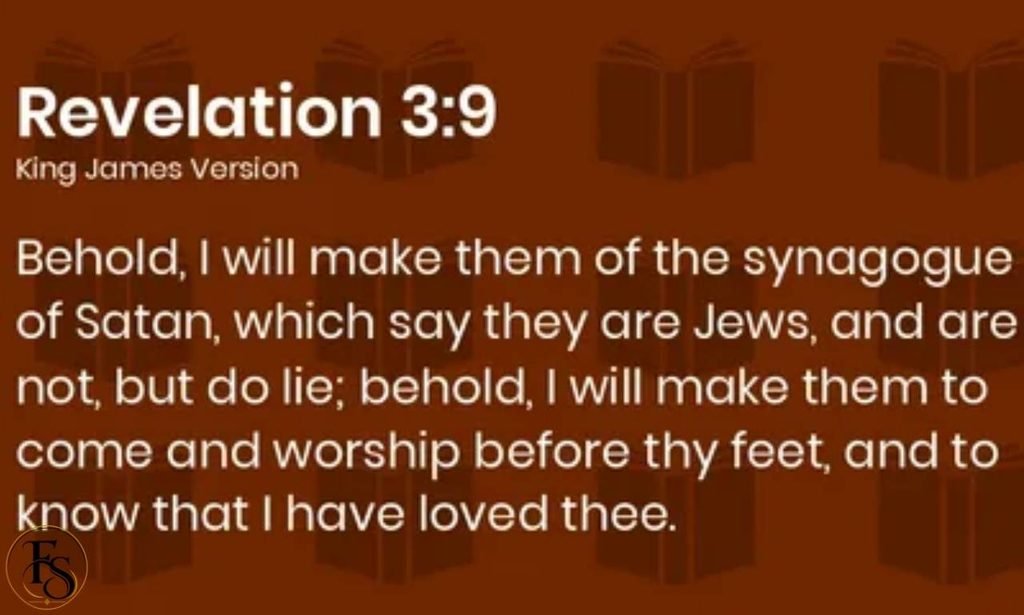
What Does “They Say They Are Jews, and Are Not, but Lie” Mean?
The next part of Revelation 3:9 concerns a disputed claim to religious identity. The text describes opponents who claim to be Jews but are said to be acting falsely.
Interpreters have offered different explanations for this language. Some understand it as a dispute over covenant identity and the recognition of Jesus as Messiah. Others emphasize the immediate conflict between a local synagogue community and the Christian congregation. These explanations are attempts to account for the wording and historical setting, rather than a reason to ignore the verse’s complexity.
Many people look for encouragement and motivation when facing challenges or difficult situations. Reading Bible verses on strength can provide inspiration, hope, and reminders of resilience through faith and spiritual reflection.
It is important to distinguish the passage’s ancient polemic from modern claims about Jewish identity. The verse does not allow readers to make sweeping judgments about people today based on ancestry, religion, or community membership.
The larger message is that outward claims and public status are not the final measure of faithfulness in the eyes of Christ. In this letter, Jesus recognizes the believers who have kept His word and refused to deny His name, even though they possess little strength.
What Does “Bow Down Before Your Feet” Mean?
Revelation 3:9 promises that the opponents will come and bow down before the feet of the faithful believers. The expression can sound surprising because Scripture teaches that worship belongs to God. In this context, however, the language is commonly understood in terms of homage, submission, or public recognition.
The image draws on Old Testament passages such as Isaiah 60:14, where former oppressors bow before Zion. The imagery describes a reversal of circumstances: those who were treated with contempt are publicly recognized, and the people who opposed them discover that they were wrong about their standing before God.
There are different views about the precise fulfillment of this promise. Some interpreters understand it as the eventual recognition of the church’s vindication. Others see a possibility that some opponents would come to acknowledge the truth and join the Christian community. The passage itself does not provide enough detail to settle every question about how or when the promise would be fulfilled.
Does the Verse Mean Christians Will Be Worshiped?
No. The central point is not that believers should receive divine worship. The wording describes a reversal in which the faithful community’s standing becomes evident to those who had opposed it.
The distinction matters because bowing can represent respect or submission in biblical imagery. The verse does not replace God with human beings as the proper object of worship. Instead, it portrays Christ as the one who brings the truth to light and vindicates His people.
For modern readers, this is a reminder not to seek revenge or demand public humiliation from those who disagree with them. The promise places the outcome in Christ’s hands.
What Does “They Will Know That I Have Loved You” Mean?
The final phrase is the emotional center of Revelation 3:9: the opponents will know that Jesus has loved the church.
The believers in Philadelphia may have been questioned, excluded, or treated as though they did not belong to God’s people. Jesus answers that pressure with a promise of recognition. Their value does not depend on the approval of their opponents. Christ knows them and affirms His relationship with them.
This promise would have been meaningful to a congregation facing social and religious opposition. It tells them that their hardship does not mean that Jesus has abandoned them.
Christ’s Love Is Not Measured by Popularity
Revelation 3:9 reminds Christians that public opinion is not the final measure of their faithfulness. A person can be rejected by others and still be known and loved by Christ. Likewise, popularity or religious status does not automatically prove that someone is living faithfully.
The passage directs attention away from the need to win every argument. The believers are not instructed to retaliate against their opponents. They are assured that Christ knows the truth and that His judgment is more lasting than human opinion.
Divine Vindication Is Different From Personal Revenge
Vindication means that the truth is recognized and an unjust accusation is answered. Revenge, by contrast, seeks to inflict suffering because one has been hurt.
Revelation 3:9 places vindication in the hands of Jesus. It does not command believers to punish people who have rejected them. Christians can seek justice, set healthy boundaries, and speak truthfully without nurturing hatred or pursuing personal humiliation.
The Historical Background of the Church in Philadelphia
Philadelphia was an ancient city in Asia Minor, in the region of modern-day western Türkiye. The church there was one of the congregations addressed in Revelation 2–3.
The letter suggests that the congregation had limited strength but had remained loyal to Jesus. It also indicates that the believers were facing opposition connected with religious identity and community relationships.
Many people seek encouragement, reflection, and support while working through personal challenges and life changes. Exploring A.A. prayers for Alcoholics Anonymous can provide insight into the role of prayer and reflection within recovery-focused communities.
The precise details of that conflict remain debated. The text does not provide a complete historical account of every person involved, so readers should be careful not to treat one proposed reconstruction as certain.
The wider setting nevertheless helps explain why the message of reassurance mattered. Early Christian communities could experience rejection and pressure as they identified themselves with Jesus. In that setting, the promise that Christ knew and loved the Philadelphian believers would have offered encouragement to remain faithful.

How Revelation 3:9 Connects With Revelation 3:8–12
Reading the surrounding verses helps explain the meaning of Revelation 3:9.
Revelation 3:8: The Open Door
Jesus tells the church that He has set before it an open door that no one can shut. He also recognizes that the believers have little strength but have kept His word and not denied His name.
This introduces the theme of faithfulness despite limited power. Their security rests on Christ rather than on social influence.
Revelation 3:9: The Promise of Recognition
The next verse addresses their opponents and promises that the truth about Christ’s love for the church will become known. It answers the pressure described in the surrounding message.
Revelation 3:10–11: Patient Endurance
Jesus commends the church’s endurance and tells the believers to hold fast. The emphasis is on continued faithfulness, not retaliation.
Revelation 3:12: The Promise to the Overcomer
The message concludes with the image of a pillar in God’s temple and the writing of God’s name on the victorious believer. These images communicate belonging, permanence, and honor.
Taken together, the verses show that Christ’s reassurance is part of a broader promise to a faithful congregation. The church is encouraged to remain loyal because its future is held by God.
What Christians Can Learn From Revelation 3:9 Today?
Although the verse addresses a specific ancient congregation, its themes can encourage thoughtful reflection today.
1. Remain Faithful Under Pressure
The church in Philadelphia is commended for keeping Christ’s word despite having little strength. Faithfulness is not always accompanied by popularity, influence, or easy circumstances.
Christians can apply this principle by holding to their convictions with patience, honesty, and humility when they experience disagreement or rejection.
2. Do Not Let Rejection Define Your Worth
Revelation 3:9 reminds readers that the faithful believers were known and loved by Christ even when others opposed them. Rejection can be painful, but it does not establish a person’s ultimate worth.
Believers can find comfort in their relationship with God while still examining their own actions honestly and accepting correction when it is deserved.
3. Leave Final Judgment to God
The promise of vindication belongs to Jesus. This does not mean that injustice should be ignored or that people should never seek help. It means that personal vengeance is not the believer’s responsibility.
Christians can address wrongdoing through truthful speech, appropriate boundaries, peaceful action, and legitimate processes without assuming the role of final judge.
4. Interpret Difficult Scripture Carefully
The phrase “synagogue of Satan” is strong and has sometimes been misused. Responsible interpretation considers the original audience, literary context, historical setting, and the limits of what the text explicitly says.
A careful reading avoids turning a local conflict into a claim against all Jewish people. It also avoids using the verse as a weapon against anyone with a different opinion.
5. Find Encouragement in Christ’s Knowledge of His People
The promise that the opponents will recognize Christ’s love offers comfort to those who feel misunderstood. Jesus sees the faithfulness that other people may overlook.
This does not guarantee that every conflict will be resolved publicly in this life. It does remind Christians that their relationship with Christ is not determined solely by the judgment of others.
Important Cross-References for Understanding Revelation 3:9
Several passages help readers understand the themes surrounding Revelation 3:9.
- Revelation 2:9: Uses similar language in the message to the church in Smyrna, where believers also face opposition.
- Revelation 3:8: Describes the Philadelphian church as faithful despite having little strength.
- Revelation 3:10–12: Continues the message with promises concerning endurance, perseverance, and the victorious believer.
- Isaiah 60:14: Provides Old Testament imagery of former oppressors bowing before Zion.
- Isaiah 49:23: Contains similar imagery of rulers bowing and recognizing God’s purposes.
- Romans 12:17–21: Encourages believers not to repay evil for evil and not to take personal revenge.
- Ephesians 2:14–16: Discusses reconciliation and the breaking down of hostility between groups.
These references do not all address the same situation in the same way. They offer context for themes such as vindication, perseverance, reconciliation, and the proper response to opposition.
Frequently Asked Questions About Revelation 3:9
1. What is the main message of Revelation 3:9?
The main message is that Jesus knows and loves the faithful church in Philadelphia and promises that its opponents will eventually recognize His love for it. The verse encourages believers facing opposition to remain faithful.
2. What does Revelation 3:9 mean in simple words?
In simple words, Jesus is telling the believers in Philadelphia that the people opposing them will come to recognize that Christ loves them. Their opponents’ accusations do not determine their standing before Him.
3. Who is the synagogue of Satan in Revelation 3:9?
The phrase describes a group opposing the Christian congregation in Philadelphia. Scholars and commentators differ over aspects of the group’s identity and the exact historical circumstances. The expression should not be used to condemn all Jewish people.
4. Does Revelation 3:9 say that all Jewish people are evil?
No. The verse addresses a particular conflict in the context of an ancient Christian congregation. It does not justify hatred, discrimination, or collective blame against Jewish people.
5. What does bowing at the believers’ feet mean?
The image generally communicates homage, submission, or recognition. It portrays a reversal in which the faithful believers’ standing becomes clear. It does not mean that Christians should be worshiped as gods.
6. Why does Jesus say, “I have loved you”?
The phrase assures the church that Jesus recognizes its faithfulness and has not abandoned it. The believers’ worth does not depend on the approval of those who oppose them.
7. How is Revelation 3:9 connected to Revelation 2:9?
Both passages use the expression “synagogue of Satan” in messages to churches experiencing opposition. Reading them together helps readers recognize the recurring theme of conflict and Christ’s reassurance to faithful believers.
8. What is the historical context of Revelation 3:9?
The verse belongs to a message to the church in Philadelphia, an ancient city in Asia Minor. The letter indicates religious and social opposition, but the precise details of the conflict are debated. The promise offers assurance to believers who remained loyal to Jesus.
9. Is Revelation 3:9 a prophecy about the end times?
Some readers connect the promise with future events and Christ’s ultimate vindication of His people. Others emphasize its relevance to the original church and the possibility of opponents recognizing the truth in history. The verse is interpreted within different Christian views of Revelation’s prophecies.
10. How should Christians apply Revelation 3:9 today?
Christians can apply its message by remaining faithful under pressure, finding comfort in Christ’s love, and refusing to answer hostility with hatred. They should also interpret its language carefully and avoid using it to attack people because of their religion or ethnicity.
Conclusion: The Lasting Message of Revelation 3:9
Revelation 3:9 is a difficult but meaningful passage about faithfulness, opposition, and Christ’s assurance to His people. Addressed to the church in Philadelphia, it promises that the believers’ opponents will eventually recognize that Jesus loves them.
Understanding the verse requires attention to its historical setting, its strong symbolic language, and its connection to the surrounding verses. The phrase “synagogue of Satan” describes the opposition portrayed in the text; it should not be turned into a general accusation against Jewish people. Likewise, the image of bowing expresses recognition or homage rather than a command for Christians to seek worship or revenge.
For readers today, the central encouragement is clear: remain faithful, act with integrity, and do not let hostility determine your sense of worth. Christ’s recognition matters more than public approval, and the promise of divine vindication calls believers toward patience rather than retaliation.